Beyond the barricades, a new political phenomenon is testing democratic institutions without necessarily derailing the country’s economic ambitions.
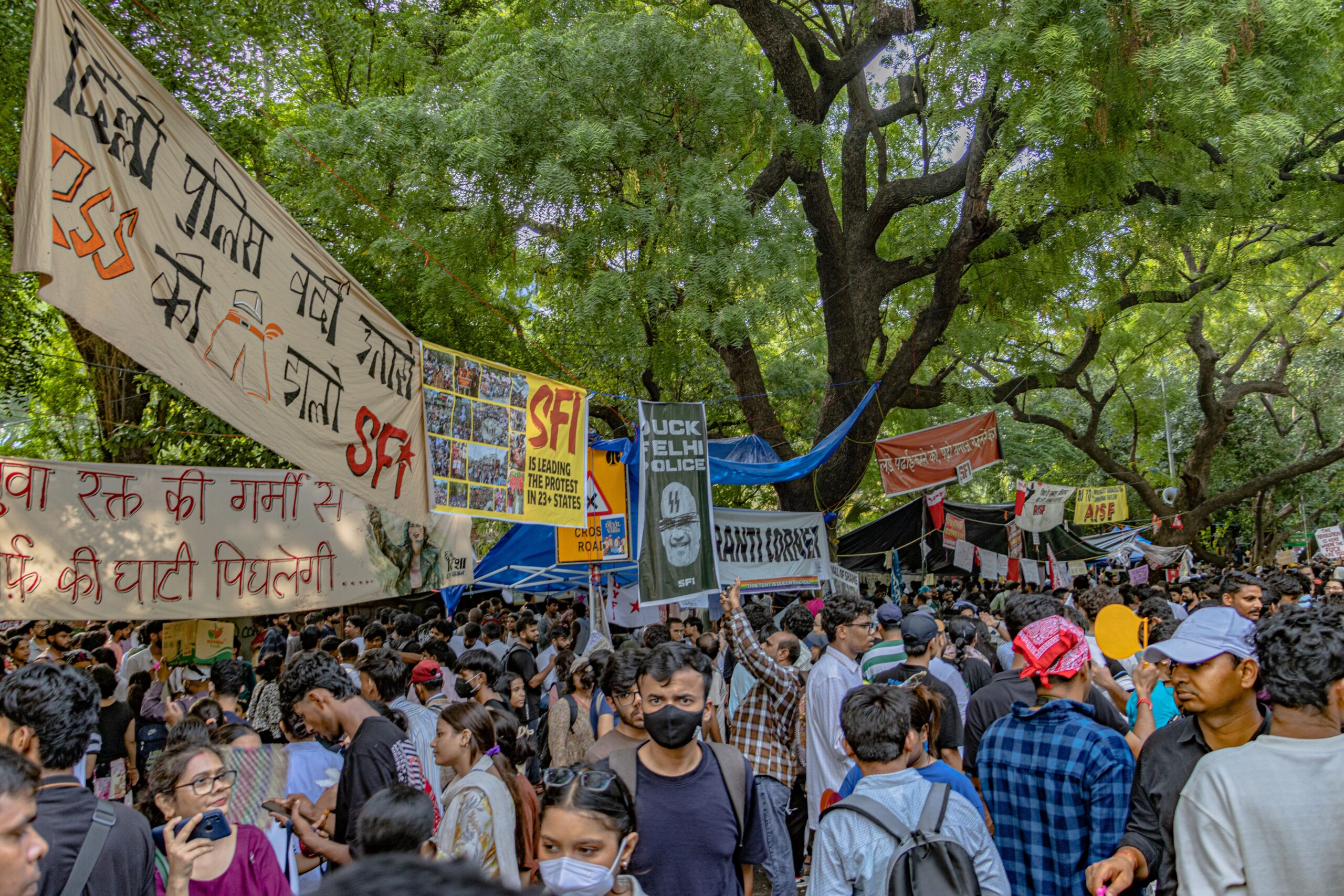
Images of barricaded streets, detained demonstrators and heightened security in New Delhi have brought India’s latest political confrontation into international focus. The scenes are striking, but their significance requires a wider lens. India is witnessing a political moment in which electoral administration, opposition mobilisation and public scrutiny are converging in an unusually visible manner. Yet, beyond the immediate turbulence, the country’s economic ambitions remain a separate and consequential story.
The question is not whether the protests matter. They do. It is whether this political flashpoint signals a deeper institutional crisis or becomes an opportunity to strengthen the democratic processes that underpin India’s long-term growth. The distinction will matter to citizens, investors and international observers alike.
At the centre of the controversy is the Election Commission of India’s Special Intensive Revision (SIR) of electoral rolls. The exercise has placed approximately 13.39 crore voter entries under scrutiny for removal from draft electoral rolls, raising concerns about potential disenfranchisement. The number is substantial, but it must be interpreted carefully. Entries flagged for deletion are not equivalent to a verified count of eligible citizens who have lost their voting rights.
The ECI-reported breakdown includes approximately 6.30 crore entries classified as permanently shifted, 3.01 crore as absent or untraceable, 2.80 crore as deceased, 1.02 crore as duplicate entries and 26 lakh in other categories. These classifications explain the administrative scale of the exercise, but they do not establish whether individual exclusions are justified.
That requires case-level verification, adequate notice, accessible appeals and reliable information on reinstatements.
The Election Commission maintains that the revision is intended to improve electoral-roll accuracy. Opposition parties and civil society groups have questioned its methodology and safeguards, arguing that eligible voters could be excluded. The Commission and the ruling Bharatiya Janata Party reject allegations of partisan manipulation.
Delhi’s protests have brought electoral accountability into sharp focus, but political turbulence does not automatically undermine India’s economic fundamentals. The real test is whether institutional scrutiny strengthens democratic credibility while sustaining the country’s growth momentum. The competing positions must ultimately be tested through evidence, transparent procedures and institutional scrutiny rather than political assertion alone.
The October 12 confrontation, when opposition demonstrators marched towards the Supreme Court demanding scrutiny of the revisions, brought these questions into the heart of the capital. Tight security and restrictions on movement transformed an administrative dispute into a visible political flashpoint. The protests also reflect the growing capacity of digital networks and youth mobilisation to bring questions of governance into the national conversation.
For a country accustomed to managing political competition across extraordinary regional, linguistic and social diversity, this intensity represents a significant democratic moment. The scale and visibility of the mobilisation may appear unfamiliar to some international observers, but protest itself is not evidence of institutional breakdown. Nor does the successful containment of demonstrations, on its own, establish that the underlying grievances have been resolved.
India’s economic trajectory must be assessed on its own terms, even as the quality of its institutions remains relevant to that trajectory. Businesses and investors look for policy continuity, predictable regulation, infrastructure development, a growing consumer market and the capacity to execute long-term plans. A political confrontation in New Delhi does not automatically invalidate these fundamentals. Equally, sustained economic growth cannot be used as a substitute for addressing legitimate questions about democratic participation.
This distinction is particularly important for India, whose growth ambitions extend well beyond the immediate political cycle. Manufacturing, digital infrastructure, services, renewable energy, logistics and domestic consumption remain central to the country’s development agenda. These sectors depend on investment, skills, institutional capacity and confidence in the future. A protest, by itself, does not dismantle those foundations. What matters is whether political uncertainty becomes prolonged enough to affect policy execution, regulatory predictability or public confidence.
For international observers, the temptation may be to interpret images of barricades and demonstrations as a verdict on India’s stability. That would be premature. A more meaningful assessment would examine the duration of the disruption, the functioning of public institutions, the availability of legal remedies, the protection of peaceful assembly and the continuity of economic activity. These indicators offer a more complete picture than the visual intensity of a single episode.
India’s growth story has never depended on the absence of disagreement. It has unfolded alongside electoral contests, regional assertions, policy debates and competing visions of national development. The country’s ability to accommodate these tensions while maintaining the direction of its economic agenda will remain an important measure of its institutional maturity.
The New Delhi flashpoint may therefore prove consequential without becoming defining. It could expose weaknesses in electoral administration and compel institutions to close existing gaps. It could also deepen political polarisation if the competing sides choose confrontation over correction. Which direction prevails will depend on the quality of the institutional response.
For now, the protests should be neither dismissed as political theatre nor exaggerated into a verdict on India’s future. Their importance lies in the questions they raise and the answers institutions provide.
The barricades will eventually come down. The more enduring question is what remains after they do. If the confrontation produces a more credible electoral process, stronger accountability and greater public confidence, India may emerge with its democratic machinery better equipped for the demands of a rapidly changing economy.
Delhi is the flashpoint. Electoral accountability is the test. India’s growth story will depend on its ability to keep reforming its institutions while moving its economic ambitions forward.
TOP WATCH
WHEN ENERGY BECOMES A WEAPON
The Strait of Hormuz is emerging as a critical pressure point in the confrontation between Iran and the United States. On October 14, Reuters reported that Iran was changing its tactics to intensify pressure on commercial shipping amid the conflict. The stakes extend far beyond the Gulf: disruption to this narrow maritime corridor threatens global energy supplies, raises transportation costs and complicates inflation management worldwide. For energy-importing economies, including India, maritime security is becoming inseparable from economic security. The diplomatic challenge is to prevent a regional confrontation from triggering a wider energy crisis.
THE SEARCH FOR AN EXIT
Diplomatic efforts to end the war in Ukraine continue, but the distance between negotiations and a durable settlement remains substantial. On October 13, President Volodymyr Zelenskyy proposed further discussions with US envoys Steve Witkoff and Jared Kushner. Washington is exploring arrangements intended to bring Moscow back to negotiations, including a proposed energy truce. Yet questions of territory, security guarantees and the future European security architecture remain unresolved. The diplomatic challenge is not simply to secure a ceasefire, but to construct an agreement that the parties can sustain. For governments beyond Europe, the outcome will influence sanctions, energy markets and the credibility of international security arrangements.
TRADE INTERDEPENDENCE MEETS STRATEGIC ANXIETY
Europe’s relationship with China is entering a more confrontational phase as concerns over Chinese exports, industrial competitiveness and strategic dependence intensify. At their October 14 summit in Brussels, European Union leaders are confronting pressure to protect domestic manufacturing while preserving access to Chinese markets. The EU’s substantial trade deficit with China has sharpened calls for intervention, including measures addressing import competition and supply-chain vulnerabilities. The dilemma is structural: restricting trade risks retaliation, while unrestricted dependence can leave European industries exposed. The debate also matters for other trading economies, which may benefit from supply- chain diversification but face mounting pressure to navigate competing economic blocs.