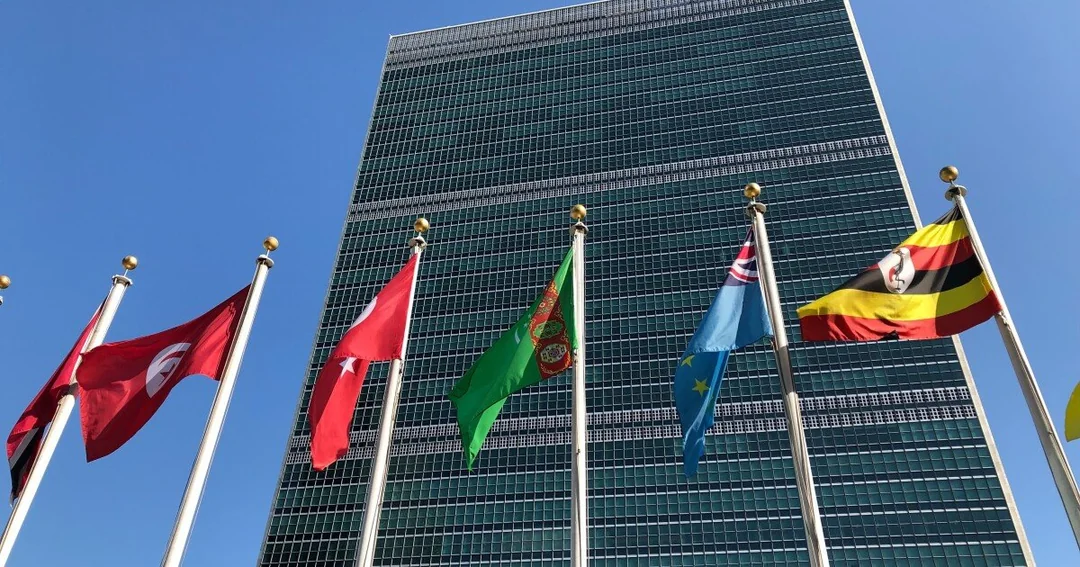
When India’s External Affairs Minister S. Jaishankar rose at the 81st UN General Assembly on 26 September, the appeal he made was as much a sermon as a ledger. He urged restraint, de-escalation and stronger protection for civilians, observing that the consequences of war are felt far beyond the borders of the nations fighting it.
The precise phrase “maximum restraint” is one the UN Secretary-General has used on Iran; Jaishankar’s own formulation, as reported, was restraint paired with an insistence on the uninterrupted flow of energy and commerce.
The reason for that pairing is written in numbers. The conflict began on 28 February, and the closure of the Strait of Hormuz on 4 March sent Brent crude past $120 a barrel, a shock the IEA has called the largest supply disruption in the history of the oil market. The strait once carried an estimated 15 million barrels a day of crude and products from the Gulf, with China and India as the principal destinations. For New Delhi, the exposure is structural: nearly two-thirds of India’s crude and half of its LNG pass through the strait in an economy that imports over 80 percent of its energy.
The damage reaches beyond the fuel gauge. Shipping costs, insurance premiums, and freight rates rise in tandem, and analysts warn that this feeds inflation, weighs on the rupee, and narrows fiscal room. Exporters are hit from the other side. Around 80 per cent of India’s merchandise trade with Europe moves through the Red Sea, and those routes together carry 34 per cent of the country’s total exports.
India has not been passive. By securing a US sanctions waiver for Russian crude, it lifted those purchases to roughly 2 million barrels a day, a pivot that left it better placed than many Asian peers.
Yet the cost has not been avoided entirely: India’s clean product exports have fallen by about 30 per cent, from 1.3 to 1 million barrels a day. Diplomacy has done its own quiet work. Jaishankar said two India-flagged LPG carriers, the Shivalik and Nanda Devi, crossed Hormuz after talks with Iran, a reminder that in a closed strait, dialogue is a form of freight insurance.
Seen this way, the UN speech was economics dressed as principle. India is a price-taker in energy markets and gains nothing from prolonged disruption; restraint is the cheapest security policy it can buy. It is also a claim of standing. By speaking for the countries “far away” that pay for wars they did not choose, India positions itself as the Global South’s most credible interlocutor, one whose credentials rest on more than rhetoric, given that its contingents serve in 9 of the 11 UN peacekeeping mandates.
The argument is also consistent. Jaishankar has warned before, at BRICS, that rising protectionism, tariff volatility and non-tariff barriers demand a defense of the multilateral trading system. A blockaded strait and a punitive tariff are, to Delhi, versions of the same problem: the weaponisation of trade routes and market access.
The indicators to watch are plain: Brent against that $120 threshold, freight and insurance on the Europe and Gulf corridors, the rupee, and the durability of the Russian crude waiver. Each is a measure of how long the world can afford a conflict that India, for reasons both moral and mercantile, is asking it to end.
TOP WATCH
Trump–Xi Washington Summit
Xi Jinping’s three-day Washington visit ended with incremental gains rather than a breakthrough. Trump greeted Xi at Joint Base Andrews on September 23, and talks and a state dinner followed through September 25. Both governments announced the outcomes on September 26: tariff cuts on $30 billion of goods, a new trade council, and a channel for handling AI-related incidents. The trade truce was extended by two months to January 10, 2027. There is no binding AI safety framework, and Taiwan’s position remained unresolved. Trump said the U.S. won’t “put on brakes” on its AI progress. AI talks resume in November.
Ukraine–Russia War
The war’s fifth year is defined by relentless air campaigns. On September 27, Zelenskyy said Russia had launched over 2,200 attack drones, 1,630 aerial bombs, and 38 missiles in a single week. Early on September 28, a guided bomb hit a Kharkiv apartment block, injuring at least 22 people, including six children. Ukraine keeps striking Russian energy targets, including a Krasnodar oil depot the same day. Analysts have noted more strikes landing, more infrastructure damaged, and more civilians killed each week. Diplomacy looks distant, and both sides are widening their target lists.
Mecca Attack
Saudi Arabia says it intercepted an attempted drone attack on Mecca overnight on September 15. On September 16, Riyadh accused Iran-backed Houthi rebels and declared the holy city a “red line.” The Houthis denied firing drones toward Mecca, about 1,100 kilometers from Yemen’s border. Iran’s foreign ministry said the claim was not grounds for accusing a specific party. The Organization of Islamic Cooperation said the attempt violated the “sanctity of holy sites.” It was the first test of a new defense pact among Saudi Arabia, Turkey, and Pakistan. The incident deepens fears of a wider Iran war spillover.