
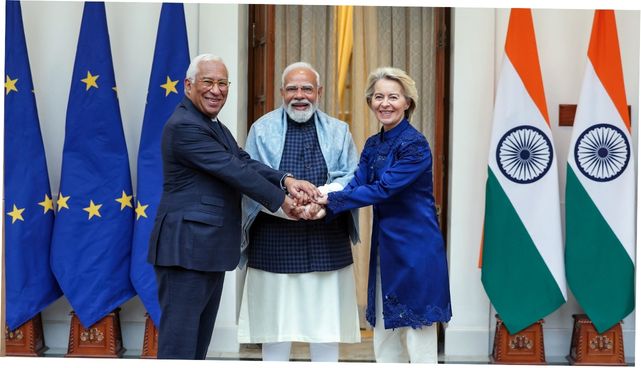
When PM Narendra Modi chose to announce the India–European Union Free Trade Agreement (FTA) by posting in multiple European languages, it was more than diplomatic symbolism. It was a clear signal to global capital and industry that India is no longer positioning itself as a peripheral manufacturing hub, but as a serious, long-term partner in the world’s most demanding markets.
The India–EU FTA is not just about tariff reductions or trade volumes. It fundamentally alters how Indian companies can plan their global expansion. Europe, with its 27-country bloc and high regulatory thresholds, has historically been a difficult market to penetrate at scale. High duties, non-tariff barriers, and fragmented standards meant that only a handful of Indian firms could sustain a presence. The FTA changes this by offering predictability—something businesses value as much as price advantage. Predictable access allows Indian companies to invest in capacity, technology, compliance, and branding with confidence, knowing that the market will not suddenly shut its doors.
For European corporates, the FTA converts India from a complex, high-friction market into a scalable growth and production platform. Until now, many European firms approached India cautiously, as tariffs, regulatory complexity, and fragmented standards limited scale. The FTA shifts this calculus.
European companies can now move from exporting into India to building in India—manufacturing locally, developing supplier ecosystems, and tailoring products to a high-volume market. This embedded presence strengthens supply chain resilience and reduces over-concentration in a small number of geographies.
Publicly available negotiating terms point to phased tariff elimination or deep cuts across automobiles and components, industrial machinery, chemicals, medical devices, wines and spirits, and clean-tech equipment—materially improving price competitiveness in India. Equally critical are commitments on regulatory cooperation, services market access, investment protection, and transparency, which reduce non-tariff barriers and policy uncertainty.
With provisions covering professional and financial services, digital trade, sustainability, and labour standards, European companies can expand in India without diluting ESG or compliance frameworks. The result is the ability to deploy long-term capital, co-manufacture, and embed India into European supply chains as a trusted, rules-based partner.
For export-oriented Indian corporates, the immediate upside lies in sectors such as textiles, apparel, leather, engineering goods, pharmaceuticals, auto components, and specialty chemicals. But the larger opportunity lies beyond exports. Europe is not merely a consumption market; it is a quality gatekeeper.
Firms that meet EU standards on sustainability, labour norms, traceability, and product safety instantly elevate their global standing. In effect, the FTA turns Europe into a certification platform for Indian industry. Once you qualify here, access to other developed markets becomes structurally easier.
This has profound implications for India’s manufacturing ambitions.