or India, the twenty-sixth SCO Summit was never really about the anniversary declaration. Strip away the pageantry, and Bishkek reveals a bloc that New Delhi has learned to use with growing sophistication not as an ideological home, but as strategic infrastructure, a forum where it can manage three relationships at once without being forced to choose between any of them.
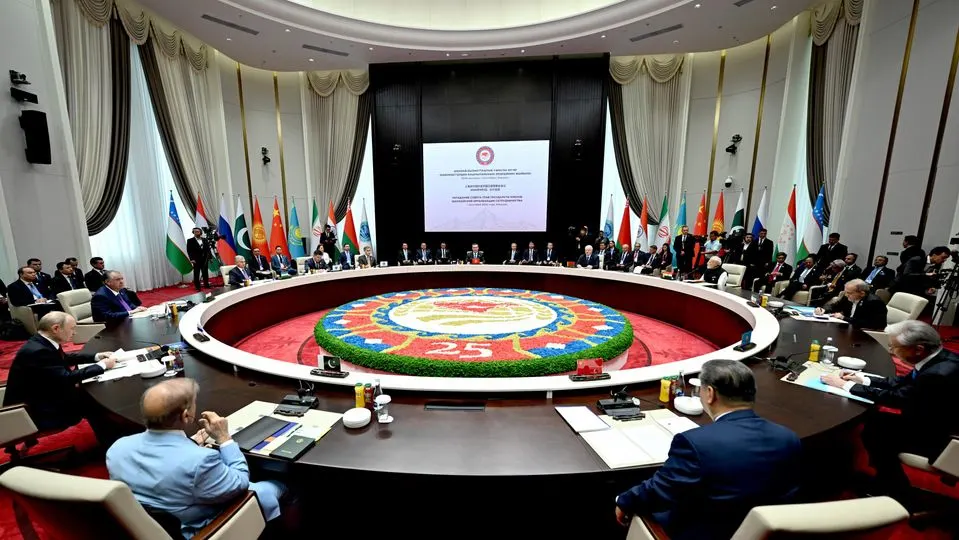
With ten member states and seventeen visiting leaders gathered in Kyrgyzstan, the summit’s true value for India lay less in its formal text than in what it enabled on the margins: sustained, high-bandwidth contact with both Moscow and Beijing, conducted on India’s own terms, at a moment when Washington’s pressure on all three capitals is intensifying in parallel.
If Bishkek produced a single moment of consequence, it was India’s. The meeting between Modi and Putin their first encounter this year, and their first since the war in the Middle East sent global oil markets into disarray was substantive rather than ceremonial. Both leaders addressed the conflicts in West Asia and the Black Sea explicitly through their impact on maritime trade and the safety of Indian seafarers, language that names Hormuz-adjacent instability as a direct security concern for India rather than distant background noise.
Defence cooperation featured prominently, the remaining S-400 deliveries, missile stocks, and the co-production of spare parts while newer threads in nuclear energy and fertiliser production suggested a elationship India is deliberately diversifying beyond its long-standing defence-and-energy core, even as Western sanctions pressure continues to bear down on it.
Strategically, the meeting accomplishes three things for India at once. It reaffirms that New Delhi will not subordinate its relationship with Moscow to pressure from Washington, even amid ongoing tariff friction over Russian oil purchases.
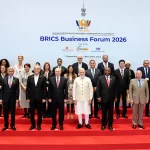
It sets the stage for what follows: Modi’s invitation for Putin to attend the BRICS Summit in New Delhi in mid-September turns Bishkek into a way-station on India’s own calendar rather than a destination in someone else’s, compressing an already dense season of Eurasian diplomacy into a sequence India is effectively choreographing.
nd it demonstrates New Delhi’s rare capacity to hold parallel tracks simultaneously courting Moscow while testing, in the same week and the same city, a cautious thaw with Beijing, all without either relationship compromising the other.
That the summit also formalized Pakistan’s incoming chairmanship, with India and Pakistan sharing a table barely a year removed from open conflict, only sharpens the picture: India can absorb friction inside a multilateral forum that it does not control, without letting that friction dictate its bilateral choices outside it.
This is the real skill on display not alignment, but leverage. The organisation was never built to resolve conflicts, and India has never asked it to.
What Bishkek offered instead was low-friction infrastructure that New Delhi could bend to its own sequencing: a single city, a single week, where India sat across the table from both Moscow and Beijing on its own terms, ahead of a New Delhi summit it will soon host. That is the strategic weight India carried out of Bishkek not what the SCO decided, but what India arranged inside it.
TOP WATCH
An update on Nepal
Nepal’s Himalayan disaster is moving from a rescue emergency to a regional economic concern. The death toll has climbed sharply, thousands remain unaccounted for, and tens of thousands need urgent assistance. India has evacuated its citizens and deployed specialist teams as relief operations continue. But the larger story is what happens next. Nepal’s damaged hydropower, roads and trade infrastructure are deeply connected to India’s economy. With reconstruction costs running into billions of dollars, the disaster exposes a vulnerability shared across the Himalayas: environmental shocks can quickly become energy, infrastructure, trade and fiscal shocks. For India, resilience in Nepal is not charity. It is economic self- interest.
BRICS Summit is coming up
ndia hosts the 18th BRICS Summit at Bharat Mandapam in New Delhi on September 12-13, under its 2026 chairship theme “Building for Resilience, Innovation, Cooperation and Sustainability”. This is the big geopolitical test. The summit will bring together BRICS members, partner countries and outreach invitees, with Putin confirmed to travel to Delhi for it. first delegation-level visit to India in seven years is also expected around this summit.
Agenda tension: Can the expanded bloc agree on de-dollarization, critical minerals, and a common line on the Iran-Israel war after failing to unify earlier this year.
UNGA High-Level Week
The 81st UN General Assembly formally opens Sept 8, with the General Debate running Sept 22-28, 2026. The theme this year? Rebuilding confidence in multilateral institutions. High- Level Week runs Sept 22-28, including Treaty Event Sept 22-25 and an SDG Moment on Sept 18.
Watch for: Ukraine-Russia talk feelers – Zelenskyy’s chief of staff has floated September talks including US representatives, plus the Secretary-General succession process heating up, and blocs using UNGA to pitch alternative energy corridors that avoid the Strait of Hormuz.