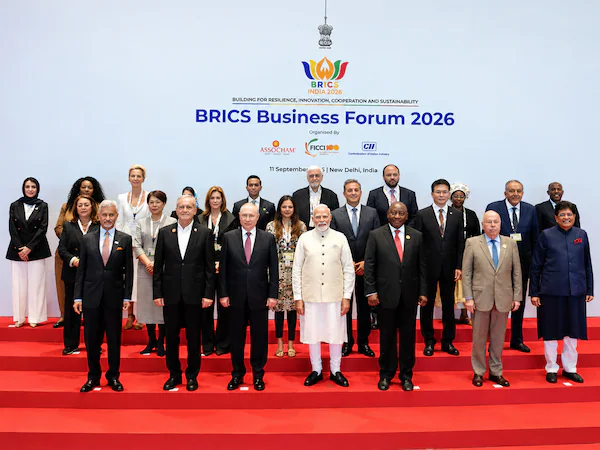
The real measure of India’s BRICS chairship isn’t what the 140-point New Delhi Declaration says. It’s what Modi extracted while saying it.
For a bloc that commands over 40% of the world’s population and approximately 30% of global GDP, BRICS 2026 chose something far more strategically valuable than revolutionary proclamation: concrete leverage. India walked away with what matters most to its foreign policy—not an upheaval of global order, but vindication of its approach to navigating it. That approach, it turns out, looks nothing like the antiWestern counterweight the West feared BRICS might become.
Consider what actually moved the needle. India secured explicit Chinese and Russian backing for its permanent UN Security Council seat—language that had been conspicuously absent from previous declarations. That is not diplomatic theater. That is a shift. For years, China hedged on India’s UNSC ambitions while Russia remained noncommittal. In a consensus declaration adopted across 11 nations— from Brazil to Egypt, Indonesia to the UAE they positioned themselves as supporters of Indian interests.
Modi orchestrated this across over 350 ministerial and high-level meetings held in 25 cities nationwide throughout 2026, building the consensus that made this moment inevitable rather than surprising. More strategically still, India embedded counterterrorism language that isolates Pakistan within a BRICS framework.
The declaration explicitly condemned the Pahalgam terror attack of April 22, 2025, in which 26 people were killed, and called for zero tolerance toward terrorism with no double standards—language that directly targets Pakistan’s narrative without naming it. In diplomatic terms, that is a thumb in Pakistan’s eye delivered by Russia and China. Pakistan is not at the table. Pakistan’s claims about “Kashmiri freedom fighters” are not validated in BRICS consensus. What matters less is what it says than what it reveals: even in a grouping that includes Russia and China nations with their own strategic complications with India the bloc’s consensus positioned Indian security concerns above Pakistani positioning.
This is leverage. Not revolution.
The Ukraine question is where India’s pragmatism became most visible. Russia, isolated by Western sanctions, needed the cover of a BRICS declaration that spoke about dialogue and diplomacy without mentioning Ukraine by name. India provided exactly that. But it did so while also ensuring the language never ventured so far that it would anger the West so thoroughly India’s strategic ambiguity becomes unsustainable. The formulation was so carefully calibrated that both Russia and the West could read vindication into it. That’s not consensus. That’s management.
The financial architecture tells the real story. BRICS did not create a common currency despite years of speculation.BRICS did not establish a parallel IMF to supplant American institutional dominance. Instead, it deepened mechanisms: the New Development Bank, BRICS Pay system for cross-border transactions, and local currency settlements that now form the operational backbone of emerging market cooperation. These are options, not replacements. And options are what India wanted. Options mean leverage. Replacement means commitment, friction, and eventual fragmentation.
India positioned the NDB for significant expansion, supporting its move into deeper local-currency financing across the Global South and backing new member accessions—concrete tools rather than aspirational rhetoric. The declaration called for UNSC, IMF and World Bank reforms reflecting contemporary economic reality, but stopped short of ultimatums. It condemned unilateral trade measures and tariffs while backing Ethiopian and Iranian accession to the WTO—moves that strengthen the coalition without requiring revolutionary restructuring.
What India gained across its fourth BRICS chairmanship was not leadership of an anti-Western bloc destined to replace existing structures. It was leverage with multiple powers simultaneously. India got China and Russia to back its UNSC ambitions. It got Arab states, African nations, and Latin American economies to recognize its development model. It positioned itself as the bridge between revolutionary rhetoric and pragmatic outcomes— the voice that translated Global South frustration into workable mechanisms rather than inflammatory proclamations.
Modi framed the outcome as institutional reform addressing a world where “outdated institutions” no longer reflect reality. Technically, it was. Strategically, it was something more precise: India secured commitments from major powers on issues central to Indian interests while maintaining the strategic autonomy that defines Modi’s foreign policy. BRICS mattered not because it challenged the international order but because it gave India negotiating power within it.
That’s not revolutionary. It’s far more durable. And in a multipolar world where influence flows to those who can manage contradictions, it may prove far more valuable.
TOP WATCH
HOUTHIS SEIZE STRATEGIC RED SEA STRAIT
Iranian-backed Houthi rebels captured a strategic island in the Bab el-Mandeb Strait, threatening Saudi oil exports through a critical commercial lane. Saudi Arabia immediately shut down a major oil pipeline after coming under attack. The advance along Yemen’s Red Sea coast signals dangerous escalation in the US-Iran proxy war, with severe implications for global energy security and shipping routes accounting for billions in daily trade. Energy prices face upward pressure as regional tensions intensify.
CHINA THREATENS SUMMIT CANCELLATION OVER TAIWAN
Beijing threatened to cancel the Trump-Xi Summit if Washington approves new arms sales to Taiwan, marking a critical juncture in US-China relations. The standoff reflects fragility in bilateral engagement even as both powers seek avoiding full trade war reignition. Both nations pursue strategic decoupling over the long term, yet tactical disputes over Taiwan threaten near-term diplomatic breakthroughs. The threatened cancellation signals how weaponized bilateral summitry has become in managing superpower competition.
THREE SUNNI NATIONS FORM DEFENSE ALLIANCE
Saudi Arabia, Pakistan, and Turkey signed the Mecca Joint Defense Agreement on August 7, forging a mutual defense pledge that aligns three major Sunni Muslim powers. The Trump administration likely supports this pact reflecting Washington’s reduced role as primary security enforcer in the Middle East. The alliance signals historic shift in how regional powers organize independent defense architecture without traditional Western security umbrellas. Middle Eastern nations increasingly pursue autonomous strategic arrangements.