
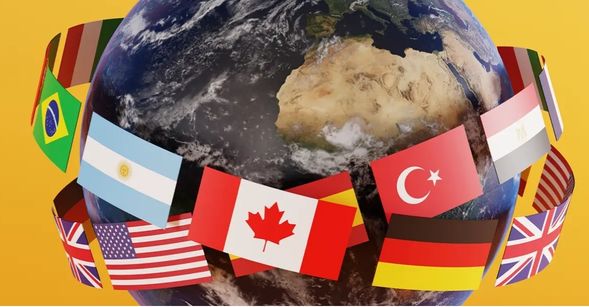
Every year announces itself with noise. Only a few announce themselves with direction. 2026 is not arriving as a rupture, but neither is it arriving as calm. It is arriving as a settling—a year in which forces long in motion harden into structure, even as instability becomes more normalized. What was once debated is now assumed. What was once exceptional is now routine. What was once deniable is now explicit. This is not a world in sudden crisis. It is a world in recalibration under strain. Global Groundlines attempts not to chase events, but to interpret power in motion. To name what has changed—and what will not return.
Davos and the Paradox of Dialogue in an Age of Geo-economic Confrontation.
As global leaders, CEOs and policymakers gather in Davos for the annual meeting of the World Economic Forum, the chosen theme “A Spirit of Dialogue” lands with a certain irony. The world arriving in the Swiss Alps is one marked less by convergence and more by fragmentation. Dialogue today unfolds against a backdrop of open conflict, hardened alliances and what can only be described as sustained geo-economic confrontation.
The wars in Ukraine and the Middle East continue to redraw security assumptions and energy flows, with no clear off-ramps in sight. The recent escalation in the Red Sea has disrupted global shipping lanes, adding inflationary pressures to already fragile supply chains. Even traditionally stable regions are not immune: Denmark has openly warned of heightened security risks amid tensions in the Arctic and the Baltic, reflecting how Europe’s strategic calm has given way to permanent vigilance. Meanwhile, renewed strains between the US and Venezuela over sanctions, energy access and political legitimacy underline how economic tools are increasingly substituting for diplomacy.
In such a world, dialogue is no longer about bridging misunderstandings—it is about managing friction. Trade, technology, capital and currency are now instruments of statecraft. Sanctions, export controls and industrial subsidies are reshaping global markets faster than treaties ever did. Davos will debate climate finance, AI governance and growth under uncertainty, but the underlying reality is that cooperation is being filtered through national interest more than shared ideology.
As the world listens to Davos for signals of convergence, India is quietly pursuing a different playbook, engaging globally but anchoring decisions at home
Signals That Set the Tone for 2026
1. The Venezuela Moment: Why Energy Politics Just Crossed a Line
The reported capture of Venezuelan President Nicolás Maduro by the United States marks a decisive escalation—from transactional energy recalibration to overt regime signalling. This moment is no longer about Latin America or oil barrels alone; it is about demonstrating how power will be exercised in this decade. Under Donald Trump’s hardline revival, sanctions, enforcement, and direct coercive action now sit on the same continuum. The message is unambiguous: economic tools can rapidly become kinetic, and sovereignty is conditional when strategic interests are at stake. Energy remains central—not just as leverage over markets, but as justification for action. For 2026, the implication sharpens further: volatility is no longer merely political by design; it is enforceable by design, collapsing the distance between financial pressure and direct intervention
2. The Red Sea–Middle East Corridor: Instability as Infrastructure
The second signal is quieter, but more profound. Attacks on shipping, rerouted trade flows, militarised sea lanes, and permanently higher insurance costs across the Red Sea and Middle East are no longer treated as emergencies. They are being absorbed—operationally and psychologically. Instability has crossed a threshold. It is no longer a disruption. It is the baseline. Global trade is quietly reorganising itself around managed risk. Logistics firms reroute by default. Governments escort commerce as routine. Insurers reprice not for peace, but for persistence. This marks a decisive shift: geopolitics is no longer interrupting globalisation. It is re-engineering it.
3. Technology Nationalism Becomes Explicit The third signal defines the decade.
Across the U.S., EU, China and other major economies, core technologies — semiconductors, AI frameworks, data infrastructure and cybersecurity systems — are treated less as commercial assets and more as instruments of national security and strategic leverage. Export controls, investment screening, and bloc-based technology alliances reflect a decisive end to frictionless digital globalisation. Innovation in 2026 is increasingly conditioned on national permission structures, not just market dynamics.
4. Geo-Economic Confrontation Replaces Traditional Conflict as the Top Risk
According to the World Economic Forum’s Global Risks Report 2026, geo-economic confrontation — the strategic use of trade barriers, sanctions, investment limits and supply-chain controls — has emerged as the number-one global risk, overtaking even armed conflict in the near-term risk rankings. This shift reflects how economic policy itself has become a frontline of geopolitical competition, directly affecting markets and alliances.
These signals together paint a picture of 2026 not as a moment of post-crisis calm, but as a year of strategic consolidation, where confrontation, competition, and geo-economic competition shape both state behaviour and global risk.