
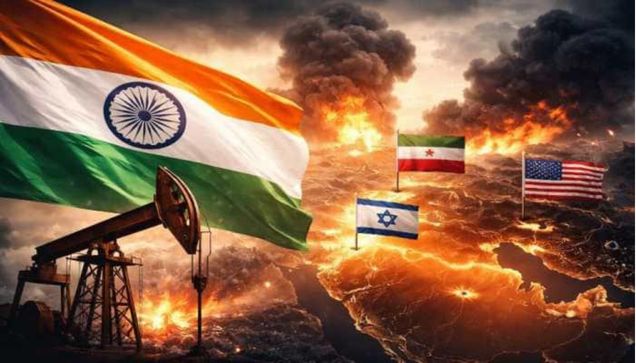
In a world rattled by geopolitical tremors, India finds itself walking a tightrope—exposed to global shocks, yet remarkably anchored by domestic resilience. The ongoing West Asia conflict has tested economies across continents. For India, heavily dependent on imported energy and global trade routes, the risks are real. And yet, the Indian economy is not buckling—it is bending, recalibrating, and holding steady.
At first glance, the headline numbers tell a story of strength. India continues to be the fastest-growing major economy, with GDP projections hovering between 7.5% and 7.6% for FY26. This growth is not incidental—it is powered by robust domestic demand, rising consumption, and sustained public investment. Unlike export-heavy economies, India’s growth engine is largely internal, giving it a crucial buffer in times of global disruption.
Yet, beneath this resilience lies undeniable stress. Equity markets have reacted sharply to the war-induced volatility. Benchmark indices like the Sensex and Nifty posted their worst fiscal performance since 2020, dragged down by foreign investor outflows, rising crude prices, and a weakening rupee. Nearly $20 billion in foreign capital has exited Indian markets, underscoring how quickly global sentiment can turn.
But here lies the essence of India’s balancing act: while foreign capital retreats, domestic capital steps in. Systematic investment plans (SIPs), retail participation, and institutional flows have increasingly cushioned market volatility.
This quiet shift—from “fragile five” dependency to domestically anchored capital markets—marks a structural evolution in India’s financial architecture.
Inflation, often the Achilles’ heel of emerging economies, is also being managed with notable discipline. India entered 2026 with consumer price inflation at a relatively benign 2.75%, well within the Reserve Bank of India’s tolerance band. Even as crude prices surge due to war, policymakers have tools at their disposal—fuel tax adjustments, strategic reserves, and calibrated monetary policy—to prevent runaway price spirals. Estimates suggest inflation may rise modestly, not catastrophically.
The Reserve Bank of India, in particular, has emerged as a key stabilizing force. By managing liquidity, intervening in currency markets, and tightening exposure norms, it has shielded the rupee from disorderly depreciation. This institutional credibility is critical in times when global investors are quick to punish perceived vulnerability.
Of course, India is not immune. Its dependence on imported oil—meeting nearly 85–90% of its needs—remains a structural risk. Supply chain disruptions, rising logistics costs, and pressure on manufacturing sectors—from glassmakers to exporters—are already visible fault lines. Growth may soften at the margins, and inflation may inch upward.
But what distinguishes India in this moment is not the absence of risk—it is the presence of buffers such as strong bank balance sheets, healthy corporate deleveraging, a consumption-driven economy and a Government willing to intervene with both fiscal and regulatory agility.
Even global observers acknowledge that India has managed war disruptions better than many of its peers. That is not accidental—it is the result of years of macroeconomic discipline and structural reform.
In the end, India’s story is not one of invincibility, but of preparedness. It is a nation that understands the fragility of global interdependence, yet invests deeply in domestic strength. In a fractured world economy, that may well be the most valuable hedge of all.
TOP WATCH
China Rewires Supply Chains Through Strategic Overcapacity
China is reshaping global trade through a deliberate expansion of industrial capacity across sectors such as electric vehicles, solar panels, and batteries. With exports surging despite slowing domestic demand, concerns are mounting in the European Union and the United States over price distortions and market flooding. Trade investigations and tariff considerations are intensifying. For emerging economies, this creates both opportunity and risk—access to cheaper inputs, but pressure on domestic manufacturing. The next phase of globalisation may not be about integration, but strategic insulation
Global South Gains Leverage in Climate Finance Negotiations
A quiet but consequential shift is underway as the Global South consolidates bargaining power in climate negotiations. At recent forums, countries led by India and Brazil have pushed for enforceable commitments on climate finance, technology transfer, and loss-and-damage frameworks. Developed economies are under increasing pressure to move beyond pledges toward measurable disbursements. With trillions required to meet transition goals, capital flows—not climate targets—are becoming the central geopolitical contest. The balance of negotiation power is slowly tilting toward those most affected
Africa Emerges as the Next Frontier for Strategic Minerals
The race for critical minerals is accelerating, placing Africa at the centre of a new geopolitical contest. Nations including Democratic Republic of the Congo and Zambia hold vast reserves of cobalt and copper—essential for the global energy transition. Competing investments from China, the United States, and European Union are reshaping alliances and infrastructure development. For African economies, this presents a pivotal moment: leverage resources for long-term industrialisation or risk repeating extractive cycles of the past