
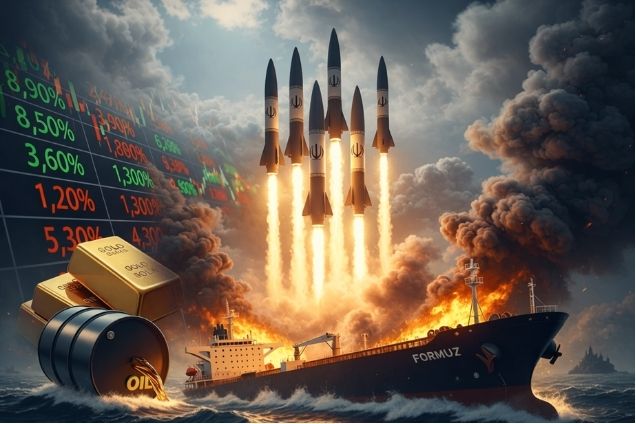
The conflict in Iran is beginning to register in India not as headline shock, but as a steady recalibration of how business operates. For a country that imports over 85% of its crude, the transmission is immediate. A $10 rise in oil prices can widen the current account deficit by up to 0.4% of GDP and push inflation higher by 30–40 basis points. For India’s 63 million MSMEs—responsible for nearly a third of GDP and close to half of exports—this is not abstract economics. It shows up directly in costs, margins and cash flow.
The first signs are already visible. Energy-linked sectors ceramics, textiles, chemicals, plastics are already absorbing input increases in the range of 5–12%. Freight has quietly turned more expensive, with shipping rates rising 8–15% as bunker fuel costs climb and war-risk insurance is repriced. For exporters operating on margins that rarely exceed 10%, this is the difference between viability and erosion. Contracts signed in a lower-cost environment are now being executed in a higher-cost one, with little room to renegotiate.
At the same time, risk itself is being priced differently. A large share of India’s crude still moves through sensitive maritime routes, and even without disruption, the perception of vulnerability is enough to change behaviour. Companies are holding more inventory—often 10 to 20 extra days—locking up working capital at a time when credit remains uneven. The rupee adds another layer of pressure; even small movements increase import bills and make hedging more complicated.
The bigger risk, though, may not be supply. It may be demand. India receives over $100 billion in remittances each year, much of it from Gulf economies. If instability continues, even a modest dip in these flows could soften consumption in key regions. A slight slowdown in hiring across the Gulf could feed back into household incomes, affecting sectors that depend on discretionary spending.
his kind of shift tends to build gradually rather than show up all at once.
Financial conditions are tightening, but quietly. Input costs are rising in high single digits, and working capital cycles in some export sectors have already lengthened by a few weeks. A significant share of MSMEs still operate with limited access to formal credit; for them, this is less a sudden squeeze and more a steady compression. Some will adjust—changing product mixes or passing on costs where they can. Others may scale down or exit without much visibility.
Even so, this is not a story of fragility. India’s scale—now a $3.5 trillion economy offers some cushion. Domestic demand remains broad, even if parts of it come under pressure. Businesses are adapting in practical ways: widening supplier bases, reworking logistics, building small buffers into pricing. Growth is not derailing, but it is becoming more conditional.
If the current situation stretches over the next year or two without a major supply disruption, these pressures are likely to settle into the background. Oil in the $90–110 range would keep inflation somewhat elevated. Export growth could ease, and overall GDP expansion may slow modestly. The rupee would remain under mild pressure, enough to keep import costs firm and planning cautious.
For global businesses, this calls for a reset in expectations. India remains a large, growing market, but the operating environment is less predictable than it once was. Costs, timelines and supply chains all carry a higher degree of uncertainty. At the same time, there is a more deliberate shift underway in how India is securing its energy. Long dependent on West Asia and exposed to the Strait of Hormuz, India has begun to actively reduce that risk.
It now sources crude from over 40 countries, widening its supplier base. A growing share of shipments is being routed through alternatives to Hormuz—up from roughly 55% earlier to closer to 70%—reflecting a conscious attempt to avoid geopolitical flashpoints.
The adjustment is visible in gas as well. With tighter supplies from the Middle East, India is increasing LPG imports from the United States, part of a broader shift toward more diversified sourcing. The supply chain is becoming more complex, but also more resilient. What this points to is a gradual change in approach. India is no longer only responding to price; it is factoring in risk more directly. Continuity is starting to matter as much as cost.
The conflict in Iran is not altering India’s trajectory in any dramatic way. But it is changing the margins and, alongside that, nudging a deeper shift in how the country thinks about energy, risk and resilience.
TOP WATCH
Energy Diplomacy in Overdrive
Amid the Iran war, India and United States are fast-tracking energy cooperation, signalling a strategic deepening beyond short-term crisis management. Talks are expanding across nuclear energy, LNG, and LPG supplies, with US exports helping India offset tightening Middle Eastern flows. The alignment reflects a broader geopolitical shift—energy is now central to bilateral ties, not peripheral. For India, this reduces concentration risk; for the US, it cements its role as a reliable supplier to Asia. The partnership is evolving from transactional trade to long-term energy interdependence shaped by geopolitical necessity.
Trade Corridors Open Amid Disruption
The upcoming India–UK Free Trade Agreement rollout in May signals continuity in global trade even as conflict reshapes supply chains. Zero-duty exports across key sectors and reduced tariffs on goods like whisky point to a calibrated opening of markets. For Indian exporters, especially in textiles and manufacturing, this offers a competitive edge in uncertain times. For consumers, it hints at price corrections. The deal underscores a key trend: while geopolitical tensions disrupt energy, trade alliances are being accelerated to stabilise economic momentum and secure new growth pathways.
Capital Markets Stay Fluid
India’s market regulator, Securities and Exchange Board of India, has allowed companies to reduce IPO sizes post-approval, a move designed to sustain fundraising momentum amid war-driven volatility. As sentiment fluctuates due to global uncertainty, this flexibility gives firms room to recalibrate without shelving listings altogether. It reflects a pragmatic regulatory approach—prioritising liquidity and market continuity over rigid frameworks. In a fragile environment, the decision could keep capital pipelines active, ensuring that businesses continue to access funding even as external shocks test investor confidence.