
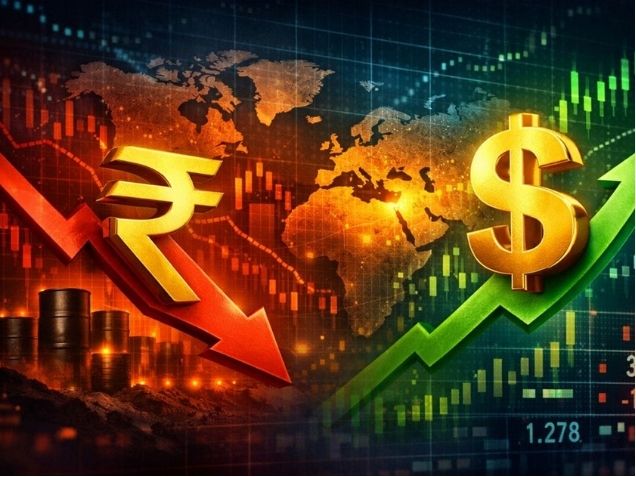
The global currency markets have entered a phase of heightened volatility as the expanding Middle East conflict reshapes the energy landscape. For India, the world’s third-largest oil importer and a major emerging-market growth engine, the geopolitical shock is transmitting through a single critical channel: oil. The result is renewed pressure on the Indian rupee, which has recently slipped to historic lows near ₹92–93 per U.S. dollar as crude prices surge and investors reassess macro risks.
At the heart of the currency story is India’s structural energy dependence. The country imports roughly 85–89% of its crude oil requirements, making it one of the most oil-sensitive large economies in the world. When crude prices rise, India’s refiners and energy companies must buy more dollars to pay suppliers, increasing demand for the U.S. currency and weakening the rupee.
That dynamic has intensified sharply in recent weeks. The escalation of the Iran-centered conflict and threats to shipping routes such as the Strait of Hormuz — through which roughly 20% of global oil supplies normally pass — has pushed crude prices above $100 per barrel, with markets briefly testing levels near $115–$120.
For India, the macroeconomic arithmetic is stark. Every $10 increase in crude prices can significantly inflate the country’s import bill and widen its current-account deficit. Analysts now warn that if oil averages around $100 per barrel through the year, India’s current account deficit could expand from about 0.7–0.8% of GDP to nearly 2%, increasing downward pressure on the rupee and forcing policy responses from the central bank. Currency markets are already reflecting this reality.
The rupee’s slide toward the ₹93 level has prompted intermittent intervention by the Reserve Bank of India (RBI), which has historically stepped in to smooth volatility through dollar sales and liquidity management.
Yet the currency outlook is not uniformly negative. India enters this episode with several macro buffers that did not exist during earlier oil shocks.
The country’s foreign exchange reserves remain among the world’s largest, giving policymakers room to stabilize markets. Moreover, India has diversified its energy procurement, with Russia now emerging as the largest crude supplier — accounting for a significant share of imports and helping moderate costs through discounted purchases.
Still, investors are closely watching a three-way macro equation: oil prices, the current account deficit, and global risk sentiment. If energy markets stabilize or strategic reserves are released internationally, the rupee could regain some footing.
But if geopolitical tensions disrupt Gulf supply chains for an extended period, the currency may face a more persistent depreciation cycle.
For foreign investors evaluating India, the broader picture remains nuanced. The rupee’s weakness reflects external shocks rather than domestic fragility. India’s growth outlook — still expected to hover near the mid-6% range even under stress scenarios — continues to outpace most major economies.
In that sense, the present moment is less a structural currency crisis than a geopolitical stress test. The trajectory of oil — not domestic fundamentals — will ultimately determine how sharply the rupee moves in the months ahead.
TOP WATCH
Manufacturing Push 2.0: India Plans Fresh Smartphone Incentives
India is planning a new incentive policy to accelerate smartphone manufacturing, now the country’s largest export sector. Replacing the current PLI scheme, the program will focus on exports and local supply chains. India produced nearly $60 billion worth of smartphones in FY2025, with $21.7 billion in exports. The move aims to help companies like Apple suppliers and Samsung expand production while keeping India competitive with China and Vietnam, supporting a broader goal of $500 billion in electronics manufacturing by 2030.
Policy Reset: India Quietly Eases Curbs on Chinese Investment
In a notable shift in economic policy, New Delhi has begun easing restrictions on select investments involving Chinese capital, particularly where the stake is minority and the technology transfer potential is high. The move signals a pragmatic recalibration after several years of tight scrutiny following border tensions. Government officials say approvals for certain sectors could now be fast-tracked to sustain industrial growth and supply-chain resilience. For global investors, the policy shift suggests India is attempting to strike a balance between national security concerns and the need to attract capital into manufacturing and technology ecosystems.
Startup Momentum Returns as Funding Rebounds
India’s startup ecosystem is showing signs of renewed momentum after a period of funding slowdown. Venture investment has rebounded to roughly $2 billion in recent funding cycles, with increasing attention shifting toward AI, deep-tech and enterprise software rather than consumer apps. Industry conferences such as TiECon have highlighted the growing role of tier-2 innovation hubs like Kanpur, underscoring the geographical diversification of India’s startup economy. For investors, the trend signals the maturing of the ecosystem: capital is becoming more selective, but the pipeline of technology-driven ventures continues to expand.