
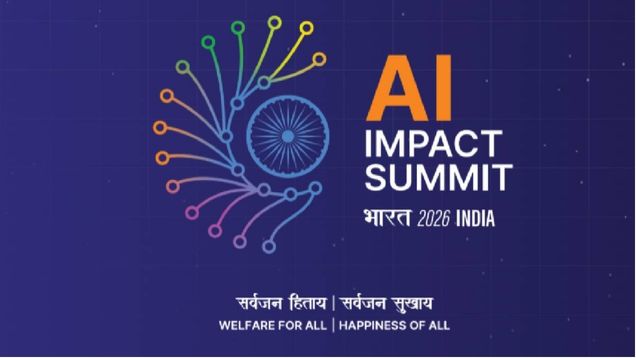
New Delhi hosting a global AI summit is not merely a matter of diplomatic prestige—it is a declaration of strategic intent. Artificial Intelligence has moved from labs and boardrooms into the bloodstream of economies and states. According to PwC estimates, AI could contribute $15.7 trillion to the global economy by 2030, with nearly $1 trillion of that value expected to accrue to India alone—the highest gain percentage-wise among major economies. Hosting this summit places India squarely inside that future, not as a spectator, but as a shaper.
What makes India’s AI moment distinctive is scale. India generates over 20% of the world’s data, has more than 850 million internet users, and adds roughly 25 million new digital users every year. No other democracy offers this combination of population diversity, data depth, and democratic complexity. India’s digital public infrastructure—Aadhaar (covering 1.3 billion citizens), UPI (handling over 12 billion transactions a month), and platforms like CoWIN and ONDC—has already proven that technology can be deployed at a civilisational scale. AI is the next logical layer.
Crucially, India’s AI narrative is developmental, not dystopian. While much of the global discourse oscillates between runaway innovation and existential risk, India is framing AI as a productivity multiplier. McKinsey estimates that AI adoption could add 1.3 percentage points annually to India’s GDP growth through gains in agriculture, healthcare, manufacturing, and logistics. In a country where 65% of the population is under 35, AI is not just about automation—it is about employability, skilling, and upward mobility at scale.
The summit also reflects India’s growing influence in global norm-setting. Today, fewer than 10 countries meaningfully shape global technology standards, from data governance to AI ethics.
By convening governments, Big Tech, startups, and civil society in New Delhi, India is asserting that standards cannot be written only in Silicon Valley, Brussels, or Beijing. Issues such as algorithmic bias, data sovereignty, and responsible AI deployment demand voices from societies that represent the next 3 billion digital users
Timing matters. AI has become inseparable from geopolitics. Semiconductor supply chains, cloud infrastructure, compute capacity, and talent mobility are now strategic assets. Global AI investment crossed $150 billion in 2024, with governments rapidly tying AI capabilities to national security, defence, and economic resilience. India’s ability to host this summit signals that it is no longer just a talent pool supplying engineers to the world, but a strategic node where technology, diplomacy, and governance intersect.
This is not soft power symbolism. It is hard strategic positioning. India understands that the AI race will not be won by the fastest models alone, but by nations that can align innovation with trust, regulation with growth, and scale with social legitimacy.
Hosting the AI summit is India stating, with quiet confidence, that it is ready to hold that balance.
TOP WATCH
India–US Trade: From Partnership to Strategic Interdependence
India–US bilateral trade has crossed $190 billion, with both sides targeting $500 billion by 2030. Recent deals spanning semiconductors, defence manufacturing, clean energy, and critical minerals underline a shift from transactional trade to strategic interdependence. As global supply chains de-risk from China, India is emerging as Washington’s most consequential economic partner in the Global South. This evolving corridor is not just about trade expansion, but about co-creating resilient, future-ready supply chains anchored in trust and shared strategic interests.
India’s BRICS Presidency: Rewriting the Grammar of the Global South
BRICS economies now account for over 36% of global GDP (PPP terms) and 45% of the world’s population. Under India’s presidency, the focus has shifted to development finance, local currency trade, and institutional reform—positioning BRICS as a platform for pragmatic multipolarity rather than ideological opposition to the West. India is steering BRICS towards practical outcomes—shifting the bloc from rhetoric to a results-driven platform for emerging economies.
India’s BRICS Presidency: Rewriting the Grammar of the Global South.
Five State Elections and the Stress Test on Internal Security
Five major state elections will place pressure on India’s internal security apparatus. With over 900 million eligible voters, rising digital misinformation, and heightened political polarisation, election periods have become stress points for law and order, cyber security, and social cohesion—testing the resilience of India’s democratic and security institutions simultaneously. The scale and complexity of India’s elections now make them a critical test of the country’s ability to safeguard democracy in the digital age.